|
 (092326)
Disclosure Day is a good, if not great, sci-fi drama about a big, cosmic,
life-changing encounter between humans and ETs. Steven Spielberg directs the
film, and when he’s at his best, he's equal parts superb artist and first-rate
showman. While it is fairly entertaining and somewhat thought-provoking, it
pales in quality compared to other recent sci-fi films like
Dune: Part 1
(2021),
Dune: Part II
(2024) and
Operation Hail Mary (2026).
In a way, the film is like a more optimistic spiritual sequel to one of his
earlier films, Close Encounters of the Third Kind (1977). Some of his more
famous films include Jaws (1975), Raiders of the Lost Ark (1981), Schindler’s
List (1993), Saving Private Ryan (1998), Minority Report (2002), and
Munich
(2005). He is widely seen as one of the best directors on the planet, but this
film suggests that he is losing his touch. His recent films, The Post (2017),
West Side Story (2021), and The Fabelmans (2022), were all worth seeing, but
they are vastly inferior to Spielberg’s masterpieces of the 70s and 80s.
The film’s principal cast includes Colin Firth (The King’s Speech), Josh O’
Conner (The Crown), and Emily Blunt, who shone in Nolan’s last film,
Oppenheimer
(2023). Blunt earned a Golden Globe nomination for The Devil Wears Prada (2006),
and is by far the best part of this film. She plays the most impressive
character and may even have a genuine shot at a Best Actress nomination,
provided the Academy voters remember her.
Daniel Kelnur (Josh O’ Conner) is a tech genius cybersecurity pro who works with
WARDEX, which stands for Waived Reporting Development and Extraction. He has a
major falling out with his employer, and he hits the road when they learn he
plans to expose the company's crimes and secrets. Daniel's supportive, religious
girlfriend, Jane Blankenship, joins him in his escape.
His boss, Noah Scanion (Colin Firth), is the film’s big heavy who will stop at
nothing, including violence and torture, to save his company from the
whistleblower. Scanion displays immense Professor X or Cassandra Nova-like
psychic powers, and at one point he mentally hooks up with Jane and tries to
compel her to kill her boyfriend mentally.
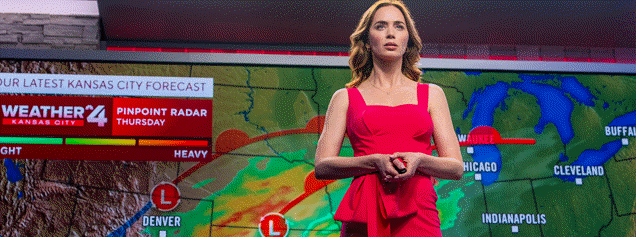
Emily Blunt plays a meteorologist named Margaret Fairchild who is committed to
exposing the truth. She is far the most compelling character, and Blunt gives
the most riveting performance. Her character, Margaret, goes on a long road trip
when alien intelligence indirectly reaches out to her. She suffers from visions
from the future and appears to have a psychic connection with extraterrestrials.
Margaret’s boyfriend, Jackson (Wyatt Russell), who some might recognize from his
role as a USA Agent in Thunderbolts, is extremely childlike. He spends much of
the day practicing guitar, dreaming he is a rock star, and eating children’s
cereal. He is clearly meant to be an out-of-his-depth normal guy the audience
can relate to, but he always seems way beneath Margaret’s league in terms of
class and intelligence. He doesn’t believe that she is contacting ETs, and he
tries to convince her to get mental help.
At some point, Margaret and Daniel team up to elude the police so that they can
release some secret files that would prove the existence of aliens and show how
the government has mistreated them in the past. They are joined by Hugo
Wakefield (Coleman Domingo), a defector from the company and military-industrial
complex with huge pockets, who heads an organization that wants to get the truth
out.
When the armed authorities follow him and try to shoot him down in several
extended chase sequences that are completely unconvincing, I kept thinking that
if this happened, it couldn't happen this way in real life. The police, who are
dressed to sort of resemble ICE agents, shoot and miss endlessly, and they seem
to be about as competent as the Three Stooges or keystone cops.
The aliens aren't the villains, but the typical gentle, little grey, big-headed
men we usually see in these films. One of the older specimens looks like he
could be a grandfather of the original ET. While they align with real ET
sightings, they are much less creative than the ones in the Alien series and The
Arrival.
What our heroes are really struggling against is the big, bad
military-industrial complex. They want info on the aliens and how they misused
and experimented on them to remain hidden. Considering that the United States
was proven throughout the 20th Century to have experimented on regular Americans,
from Tuskegee to early civilian LSD covert ops to MK Ultra, these experiments in
the film
are not very hard to believe. Toward the end, we see a barrage of images
supposedly from long-hidden secret government files. The footage, presented as
some extraordinary elevation, is no more shocking than the real footage
President Trump released a few years ago.
The film’s final message that empathy is an evolutionary process, and it might
be what saves us, might have been convincing decades ago, but it seems
hopelessly naïve today. If we can’t even treat people without green cards as
human beings, it seems unlikely that we would accept extraterrestrials or ever
give them any rights. Frankly, I expected a little more from Spielberg. In these
days of high movie prices, I expect more than a slightly above-average episode
of The X-Files, even though I loved that series. But if you like sci-fi or are a
big Spielberg fan, you still might want to give the film a look. Despite
occasional credibility gaps, it’s still a pretty good time.
|