|
 (022326)
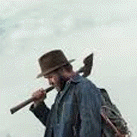
Train Dreams is a powerful and emotionally charged film about a day laborer in
the lumber industry who undergoes major changes throughout his life. The film is
set in the early 20th century, in the American West, as trains were being built
and the territories were still joining the Union. The film's quiet tone might
remind some viewers of
Nomadland (2020).
The film makes great use of stunning scenery from all over the Pacific
Northwest, including Spokane, Snoqualmie, Tekoa, Metaline Falls, and Colville (022326)
Train Dreams is a powerful and emotionally charged film about a day laborer in
the lumber industry who undergoes major changes throughout his life. The film is
set in the early 20th century, in the American West, as trains were being built
and the territories were still joining the Union. The film's quiet tone might
remind some viewers of
Nomadland (2020).
The film makes great use of stunning scenery from all over the Pacific
Northwest, including Spokane, Snoqualmie, Tekoa, Metaline Falls, and Colville
The film was nominated for several major Oscars, including Best Picture, Best
Adapted Screenplay, Best Cinematography, and Best Original Song. The film was
also selected as one of the top 10 films of the year by the National Board of
Review.
There were lots of major talents involved in the film. It was based on a novella
by Denis Johnson, who co-wrote the script with the director, Clint Bentley.
Bentley is a fairly new filmmaker, and he debuted with the well-regarded Indy
film Jockey (2021). He has already been nominated twice for the Oscars for
writing
Sing Sing
(2023), which was on my top ten films of the year in 2024, and
now Train Dreams.
Joel Edgerton gives a quiet, understated, and effective performance as Robert,
and his face always conveys much, even when he speaks few words. Edgerton is
impressive because he expresses so much by doing and saying so little. Edgerton
appeared in the Australian TV series The Secret Life of Us and the Star Wars
films Attack of the Clones (2002) and Revenge of the Sith (2005). It’s a bit odd
to see a person who has done so much sci-fi is so good in the exact opposite
kind of film, completely devoid of special effects, action, and loud, flashy
visuals.
The film also stars Felicity Jones, who is another Star Wars/genre film graduate. She
was in Rogue One: A Star Wars Story (2010) and
Amazing Spider-Man 2
(2014) as well as The Theory of Everything (2014), but she may have done her
best work playing Ruth Bader Ginsburg in On the Basis of Sex (2018) or as a
tortured, physically weak Holocaust survivor,
The Brutalist
(2024)
The film begins with a series of short dream vignettes from the point of view of
the main character, an American frontiersman named Robert Grainier. He is
totally dependent on wood. In his eighty-year life, he cut down trees almost
every season until he became too old. What makes him so remarkable is that he is
so completely unremarkable. There were thousands just like him, but we rarely
see stories like his in film.
At first, he barely ekes out a living in the long-term industry, working long
hours for little pay. But his Chinese coworker has it even worse and is the
victim of extreme racism. One day, shockingly, in front of Robert’s eyes, the
Chinese laborer was dragged off by a large lynch mob and never seen again.
Presumably, his coworkers murdered him because they saw him as competition.
Considering the current situation, this shows us how little things have changed
in a century. Society always needs to find scapegoats instead of the real
causes.
He meets an outwardly pious but unscrupulous man nicknamed Apostle Frank, who
encourages him to look towards religion. Robert begins attending church, and at
one of the masses, he meets a humble beauty named Gladys (well played by
Felicity Jones). Although Robert is not that spiritual (he is a basic guy), he
keeps coming to church in the hopes of seeing her. Conversations and long walks
in the woods follow, and Gladys is the only person the quiet Robert can connect
with on a deep emotional level. Her character is always patient and supportive,
and she seems to be an ideal companion for Robert.
When he proposes, it seems like destiny or an inevitable conclusion. She laughs
in reply and says, “We are married, now all we need is a ceremony to prove it.”
The sex scenes are refreshingly non-explicit and understated; in one scene, the
couple is shot from above their shoulders, but from their movements, we know
what is going on.
Things progress much as you would expect, and early in the marriage, the happy
couple has a child. Gladys tries to help him find jobs in the vicinity so the
family can stay together, but he eventually has to travel far for an extended
period, and he misses his family terribly. He is able to come back, but the
situation is not permanent, and he experiences a great tragedy. When he gets
another chance at happiness, will he take it?
The film ends with a lovely song titled "Train Dreams," after the film, whose
lyrics were allegedly composed by the Americana-inspired post-punk/Goth artist
Nick Cave while he was dreaming during a screening of the film. The lyrical
content perfectly goes with what happens in the movie and parallels the dream
vignettes that the film opens with. Also, the dominant images in his line,
“Lately I’ve been having dreams/crazy dreams I can’t explain/of a woman standing
in a field of flowers and a screaming locomotive train, “ come directly from the
film. Although it is a dark horse nominee, the song was nominated for a Best
Original Song Oscar.
After they get through the film, viewers may feel like they experienced a whole
life, complete with all its ups and downs. It is not the best or most
sophisticated drama of the year, but few biographies since Richard Linklater’s
Before Sunrise series and his Boyhood have had as much cumulative emotional
power as this film, and there is great beauty in its simplicity.
|