|
 (011826)
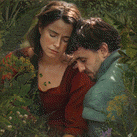
The film Hamnet is a moving and emotionally resonant historical drama about the
relationship between William Shakespeare (Paul Mescal) and his wife, Agnes
(Jessie Buckley). So far it has received great acclaim from the awards community;
earning eight
Golden Globe nominations and winning both Best Motion Picture Drama and Best Actress
in a Motion Picture. It was also picked as one of the best films of 2025 by the
prestigious American Film Institute. (011826)
The film Hamnet is a moving and emotionally resonant historical drama about the
relationship between William Shakespeare (Paul Mescal) and his wife, Agnes
(Jessie Buckley). So far it has received great acclaim from the awards community;
earning eight
Golden Globe nominations and winning both Best Motion Picture Drama and Best Actress
in a Motion Picture. It was also picked as one of the best films of 2025 by the
prestigious American Film Institute.
The film is based on
the speculative novel of the same name by Maggie O'Farrell, which was inspired
by Steven Greenblatt’s essay, “The Death of Hamnet and the Making of Hamlet,” a
well-regarded work of New Historicism. New Historicism views historical accounts
as flawed or imperfect because they are influenced by the historical moments and
power dynamics of the era in which they were produced. New historicist works
tend to examine the perspectives of people on the margins left out of
traditional historical accounts, such as Shakespeare’s wife. The following
passage from Greenblatt’s essay contains the main idea that the whole film
revolves around: "Whatever he determined at the time, Shakespeare must have still been brooding in
late 1600 and early 1601, when he sat down to write a tragedy whose doomed hero
bore the name of his dead son. His thoughts may have been intensified by news
that his elderly father was seriously ill back in Stratford, for the idea of his
father's death is deeply woven into the play. And the death of his son and the
impending death of his father - a crisis of mourning and memory - could have
caused a psychic disturbance that helps to explain the explosive power and
inwardness of Hamlet." (Greenblatt, 2004, p. 8)
This is a career high point for Chinese-born director Chloe Zhao (Nomadland, The
Rider, and
The
Eternals), who is much better at art films than superhero flicks.
She is only the second of three women to have won an Academy Award for Best
Director. The others are Kathryn Bigelow for
The Hurt Locker
and Jane Campion for
The Power of the Dog. She is very good at creating low-budget indie and art
films, but the ugly, overstuffed
The
Eternals film completely squandered her
considerable talents.
The film stars the magnificent Irish stage actress, Jessie Buckley in one of the
year’s best performances. Her earthy
performance is simply extraordinary. She has a serious shot at winning a Best
Actress Oscar this year. Her past resume includes The Lost Daughter (2021), Men
(2021),
Women Talking
(2022), and she will also be in Maggie Gyllenhaal’s
upcoming Frankenstein revisionist film, The Bride (2026).
Buckley’s more-than-adequate costar is Paul Mescal, who plays a very
unsympathetic William Shakespeare. Mescal has been very busy as an actor
recently. He was in The Lost Daughter (2021), Aftersun (2022),
Gladiator 2
(2024), and History of Sound (2025)
The film’s story is mainly seen through the eyes of Agnes (Buckley) Hathaway.
She starts as a kind of a neo pagan wild child who the villagers spurn for
practicing witchcraft. William, who is never named here, has a family in debt,
and he begins tutoring a young man who turns out to be the brother of the
beautiful young Agnes. William is immediately smitten with her. She also
impresses him by treating his wound, demonstrating her healing skills and
knowledge of herbs. The initial scenes of a young Shakespeare wooing her with
the tale of Orpheus are nearly as fresh and thrilling as a real romantic
relationship. Some Christians might be alarmed by this film’s glamorization of
nature worship and witchcraft, which seems to fit in well with modern feminism
and new historicism the film espouses.
Neither of the main characters is seen as an ideal marriage partner by
relatives. She is seen as a hermit, a witch, and an outcast, while he is viewed
as a penniless actor/director with few prospects. But eventually the two get
married anyway, over the strong objections of both families, particularly
Agnes’s mother, played by Emily Watson. They ultimately have twins, the female
Judith and male Hamnet. Like a good nature worshipper, she gives birth to the
kids unaided by doctors or drugs in the woods.
William ends up being a passable provider but an inadequate dad. He neglects his
wife and kids and spends most of his time in Stratford working on plays. His
drama career is the real center of his life. He was not even there when his son,
Hamnet, died of the plague. The loss of their son while Shakespeare is off in
Stratford nearly shatters Agnes’s delicate psyche and comes close to permanently
destroying the marriage. Much of the film is tragic, but it culminates in a
glorious, dramatic scene that gives meaning to the suffering of the two lead
characters. The film suggests that without the suffering, you probably would not
have had the play.
The film looks gorgeous. Some of the exquisite landscape shots by
cinematographer Lukas Zai are almost unbearably beautiful and recall some of
Johannes Vermeer's best paintings. Also, the son is filmed in a way that makes
him always look idealized or saintly in the light, through the use of halo-like
effects.
The film was obviously made to de-romanticize traditional biopic tropes and to
show firsthand the cost of creativity to the artist’s family. It also serves as
a corrective to some of the myths surrounding male genius. Although the film's
look is more interesting than its story, I would not call it entertaining; it is
usually compelling and thoughtful.
|