|
 (091626)
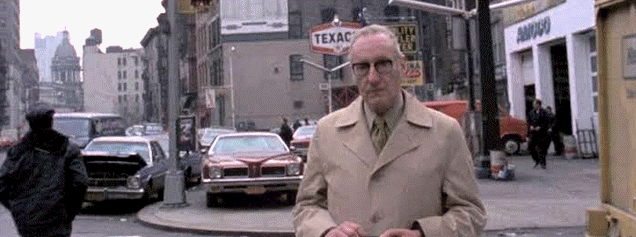
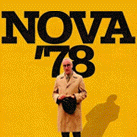
Nova’ 78 is a terrific, rewarding new documentary assembled from clips from a
major three-day art event in New York back in 1978. The footage, which was lost
for decades, was recently found, and the film’s directors, Aaron Brookner and
Rodrigo Arelas, cherry-picked the footage and assembled it into an entertaining
and thought-provoking time capsule of the period, which includes complete
performances with minimal commentary. Brooker was friendly with the beat writers
and had earlier made a doc about William Burroughs, Burroughs: The Movie (1983).
The directors were assisted by Tom Dicillo, an important cinematographer, and
Jim Jarmusch, who became a truly great first-rate director, with 2016's Patterson
being his best to date. (091626)
Nova’ 78 is a terrific, rewarding new documentary assembled from clips from a
major three-day art event in New York back in 1978. The footage, which was lost
for decades, was recently found, and the film’s directors, Aaron Brookner and
Rodrigo Arelas, cherry-picked the footage and assembled it into an entertaining
and thought-provoking time capsule of the period, which includes complete
performances with minimal commentary. Brooker was friendly with the beat writers
and had earlier made a doc about William Burroughs, Burroughs: The Movie (1983).
The directors were assisted by Tom Dicillo, an important cinematographer, and
Jim Jarmusch, who became a truly great first-rate director, with 2016's Patterson
being his best to date.
The film, which was an attempt to capture a “lower east side Woodstock,” is part
of the Chicago Underground Film Festival, which runs from Wednesday, September
23 to Sunday, September 27. Most screenings are at the Gene Siskel Center at 164
N. State Street in Chicago and the Harper Theatre at 5238 S. Harper Ave in
Chicago. The festival has shown some of the most inventive, genre-defying films
that often avoid or subvert mainstream traditions. It is the longest-running
underground film festival. Passes are $100, and tickets are $15 for individual
screenings. For more info, visit their website at
Chicago Underground Film Festival.
Nova ‘78 is playing on 9/23 at 8:00 pm at the Gene Siskel Center.
The event, which was named after Nova Express (1964), a Burroughs novel, was an
avant-garde art festival held to commemorate the long-awaited return of the
great Beat Generation writer, William S. Burroughs. Burroughs (1914-97) was best
known for his novel Naked Lunch (1959) and his considerable influence on
cyberpunk. He lived in exile for several decades in Latin America, South Africa,
and Europe to avoid prosecution. There were drug charges leveled against him. He
also accidentally shot his wife and killed her in a William Tell game when he
tried to shoot an apple off her head. Burroughs was known for his cut-up method
of writing, in which he took sentences or phrases from other sources and
reassembled them, sometimes arbitrarily, similar to the type of poem called
“centos.” Thom Yorke of Radiohead, Kurt Cobain, and Iggy Pop.
The terrific Avant Garde event features performances from the elite in the New
York art world in the late 70s. It took place as the old experimental art giants
of the beat and hippy movements were fading, and punk rock, new wave, and no
wave were taking over. The film includes both the old and new guard and features
contributions from Laurie Anderson, John Cage, John Giorno, Allen Ginsberg,
Timothy Leary, Ed Sanders, Patti Smith, Anne Waldman, Robert Anton Wilson, and
Frank Zappa.
Besides the performances, the film also includes a bizarre and shocking little
film within a film. In it, William Burroughs, dressed as a doctor, performs a
gory surgery procedure while the nurse in the background acts sexy, stretches
his legs, and throws darts at a dartboard, which for some reason is in the
hospital room. Before he operates, he proclaims, “Get me a new scalp. This one
has no edge,” which can be seen as a statement of his dissatisfaction with the
blandness or timidity of contemporary art. The short film within a film is
exactly the kind of thing you would expect at a really hip avant-garde film
fest.
The film has a wonderful sense of randomness. The festival heads gave Patti
Smith the uncomfortable job of telling the audience that Keith Richards, whom
Smith idolized, would not be showing up to the show. Smith apologized to anyone
disappointed, and she said, “I’ll give refunds to anyone who feels very unhappy
about this; I have twelve dollars in my pocket.” Smith also blows a Clarinet as
she performs her Symbolist-inspired poetry, including a rousing version of Fire
of Unknown Origin, her ode to one of her biggest idols, Jim Morrison, and it was
later recorded by Blue Öyster Cult (yes, they are the band in the classic SNL
cowbell skit).
One of the first performers is Anne Waldman, one of the resident poets at the
Naropa Institute of Disembodied Poetics, a prestigious poetry school started by
Allen Ginsberg (I have a few acquaintances who went there). She does Plutonium
Ode, a gutsy political rant that criticizes our government’s policies, which she
originally performed at a protest outside a nuclear power plant.
The film also includes a performance by the eclectic and courageous Frank Zappa,
who has been described as the world’s best progressive folk jazz doo-wop
classical humorist rock artist. Zappa had long been known as a champion of free
speech, and he even testified before Congress to fight for freedom of speech
against the PMRC. So it is unsurprising that he wanted to recite one of
Burroughs's most controversial and profane passages: a shocking section from
Naked Lunch, narrated by the main character’s talking sphincter. Burroughs was
inspired to write the scene after seeing the classic horror anthology film from
England, Dead of Night, which featured a dummy that took over the
ventriloquist’s speech.
William Burroughs reads an impassioned letter he wrote objecting to a proposed
bill called Proposition 6. The bill, which was championed by right-wingers,
would have made it mandatory to fire teachers engaging in homosexual activity
and also instructors who defended the lifestyle. Like many of the Beat
Generation writers, Burroughs himself was bisexual.
The modern classical composer Phillip Glass performs two mesmerizing numbers in
one of the film’s best musical sequences. He performs Dance 2, a hypnotic number
played on the Farishta organ, as well as a more complex and haunting excerpt
from his classic opera, Einstein on the Beach. Some audience members who came to
see Richards booed in disappointment when they heard Glass play.
One of the best experiences I ever had in a theater was when I saw a screening
of Jean Cocteau’s “Le Bébé et la Belle” (still the best film version of Beauty
and the Beast) while Glass played his cool, rich score behind the screen, and
Glass also had a hysterical cameo on The Simpsons show.
Other standouts include John Cage, who utters nonsense syllables while his
frequent collaborator, Merce Cunningham, dances; Allen Ginsberg, who changes
William Blake’s Tyger Tyger into a catchy song and (he also does a poetic
critique of punk rock); as well as Laurie Anderson, who uses technology to alter
her voice when she is saying the words of different characters. The film also
features performances by poets featured on Dial a Poem, an old series in which
people could call to hear a different poem every day (I remember using this).
John Giorno, Andy Warhol’s lover, does a spoken piece, Grasping at Emptiness, in
which recorded voices are overlaid on his voice, which does a good job of
unsettling the audience. Ed Sanders of the Fugs (also the author of a
well-received Charles Manson bio called The Family) does a memorable poem while
playing hand synthesizers.
The film is a must-see for anyone with even the slightest interest in the
avant-garde, the counterculture, Fluxus, radical performance art, beat poetry,
minimalism, or just plain weird performances. It ranks alongside superb
performance films like Poetry in Motion and the PBS documentary Words in Your
Face, which aired on PBS’s Alive from Off Center. But it would have been even
better if the show had included Yoko Ono, who would have fit right into this
scene, a little avant-garde jazz, which was the preferred music of the Beats,
and/or No Wave, also called punk jazz performers such as James Chance and Lydia
Lunch, who were also influenced by Burroughs.
|