|
 (080526)
The Odyssey is a very controversial war/fantasy/drama that has been a big hit
with general moviegoers. Like many of Christopher Nolan’s films, it attracts
people who normally don’t even go to the theatres. Nolan is so well
respected and well-known that, like a Tarantino film, a Christopher Nolan film
is virtually its own genre, and his name alone is enough to get large numbers of people to
see his films in theatres. (080526)
The Odyssey is a very controversial war/fantasy/drama that has been a big hit
with general moviegoers. Like many of Christopher Nolan’s films, it attracts
people who normally don’t even go to the theatres. Nolan is so well
respected and well-known that, like a Tarantino film, a Christopher Nolan film
is virtually its own genre, and his name alone is enough to get large numbers of people to
see his films in theatres.
The film is loosely based on Homer's epic poem, which I read about 30 years
ago, but many parts of the film intentionally subvert the original story. The
movie is based on
Emily Wilson's modernized translation of the story, which I am currently
reading. To date this version has already garnered tremendous critical acclaim, and during
the first week, only three major critics panned it. Most of the praise and
excitement has been richly deserved.
The story is about a man named Odysseus the Greek king of Ithaca who with his
soldiers go to to fight in
the Trojan War. After the defeat of Troy, he and his men head for home and have
and have a series of fantastic adventures along the way. As Odysseus tries to return
home to his
devoted wife, Penelope and their son, the journey he and his men take turns into
a 20 year odyssey of one adventure after another. They encounter a
cannibalistic cyclops (in the sequence closest to horror), fall prey to the
seductive charms of the goddess Calypso (a lovely 50-something Charlize Theron), and
later the sorcery of Circe (Samantha Morton). It is either implied or shown that
the flawed hero commits adultery with the last two women.
After a brief rap by Travis Scott, which ties hip-hop to traditional spoken word
and classical literature, The Odyssey flashes back to a scene that effectively
retells the famous Trojan Horse story. With his men, Odysseus (a more sullen
than usual Matt Damon) constructs a wooden horse as a gift, and the men hide
inside so that they can get across the wall. Once the Trojans accept the gift,
Odysseus and his men jump out of the horse and kill their enemies, then plunder
the kingdom. This part of the plot was famously brilliantly mocked in Monty
Python and the Holy Grail, one of the most hilarious films in cinema history.
There are several things that Odysseus’ men do to create animosity toward the
Greek gods (portrayed here as natural elements). They anger Zeus by violating the hospitality law and irritate
Poseidon by killing his son, the huge and grotesque cyclops, who is portrayed somewhat
sympathetically. The whole cyclops episode and the sacking of Troy are two of the
greatest and most brilliant sequences in the film.
Historical accounts and the original poem say the war began when Helen, the most
beautiful woman in the world, left her husband for the Trojan prince Paris. Many
internet critics complained that Lupita Nyong’o was not beautiful enough to play
her, and other people attacked those people for being racist for not thinking a
black woman could be the most beautiful. To a certain extent, beauty is, of
course, subjective, but the film also sidesteps the issue. The subject is
rendered moot because, whatever one thinks of Lupita’s beauty, the film shows
that her elopement with the Paris was merely an excuse for the
war, which was really fought over the Greek's quest for better trade routes.
There was also some controversy over the casting of a trans actor, Ellen Page, and
the rumor that he was cast to play Achilles (which turns out to be false). In the film,
she plays Sinon, a character who is essentially a blood sacrifice during the
war, about whom he feels unending guilt. Sinon’s role was to stand outside the
horse and announce that it was a gift, which led to his immediate slaughter. It
was a bit ridiculous to see the now 37-year-old Page playing a barely legal
male, and it disrupts the film and throws the audience out of it. This was one
of the film’s few big mistakes.
Odysseus had been gone for many years, and most did not expect him to return.
His wife, Penelope (Anne Hathaway), the queen, must contend with many suitors
who disrespect her and her family, abuse their hospitality, and only hang around to
marry her so they can become king. The son, Telemachus (played by Tom Holland),
is understandably mortified by all this, and he is one of the only ones who is
optimistic that his dad will return. He continues his quest to gather
intelligence on his father’s whereabouts.
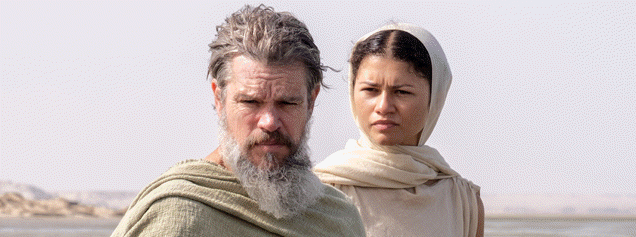
Matt Damon and Anne Hathaway, as well as Zendaya (playing Athena, an ally of
Odysseus), Tom Holland (as the son of Odysseus), and Jon Bernthal (as Menelaus,
king of Sparta) do some of the most impressive acting of their careers. The last
three are, of course, scheduled to reunite in the upcoming Spider-Man: Brand New
Day film as M.J., Spider-Man, and the Punisher, and we got to see them in the
preview strategically shown before the film.
Penelope feels great pressure to take on a new husband, and although she still
loves and misses Odysseus, she is tempted to remarry to protect her family from
the city. A small number of servants provide food and hospitality for the
competing suitors following the will of their absent master. Odysseus also had
ordered Penelope to take a husband for the good of the family if he did not
return after a certain period. After he hears how a fellow soldier was killed by
his wife upon his return, an alienated and PTSD stricken Odysseus decides to lie
low, and he disguises himself as a beggar. This eventually leads to his
encounter with the suitors as the film reaches its violent conclusion.
The film was shot entirely on IMAX in 70 millimeters, and many people are
spending extra money to see it on a bigger screen (opting out of the more
economical standard alternative). It takes place in ancient Greece and
western Mediterranean, but it was shot in Morocco, Italy, Scotland, Malta, as well as the
Western Sahara, plus some parts of Greece.
Written and directed by the often-brilliant Christopher Nolan, who
also did the Dark Knight trilogy (2005-2012),
Inception
(2010), which may have
been his best film, Interstellar (2016), and
Oppenheimer
(2023), which is just
as long and nonlinear as The Odyssey and also only slightly better. Nolan has a
well-earned reputation as one of the finest working filmmakers, and this film
should not change that.
Internet trolls were probably not mad about the project's high quality, but
about the fact that this version violated a sacred text. People’s reactions to
it are comparable to the criticisms and complaints conservatives and purists had
about The Last Temptation of Christ. What we ended up with was not the
definitive Bible Jesus Christ story, but a very good adaptation of a novel that
presents a gnostic, non-canonical view of Christ. And what we get here is not
the definitive traditional telling of the Odyssey, but an excellent version that
deconstructs the basic story, based on Emily Wilson's translation that
modernizes it.
When I was trying to think of how to rate this film, I found it difficult. I was
reminded of a review Robert Christgau wrote about The Clash’s classic
Sandinista. He wrote that “if this album is their worst, which I think it is, I
think, then this must be the best band on the planet.” I kind of feel similar
about the film. Even when Christopher Nolan has an off moment or does not
completely succeed as he does here, his films are still much more rewarding than
those of almost any other current filmmaker.
I have one major criticism of The Odyssey, which could ruin the film for some
viewers. Some great films of the past, like
The Northman
or The Big Easy, and
even the recent Dune films, were able to completely and convincingly transport
the audience to an alien place and/or to our time.
When Pier Paulo Pasolini made films set in ancient Rome and Greece, like The
Decameron (1971) and Arabian Knights (1974), he used contemporary settings that
most closely resembled the cultures or countries he depicted, often casting
local peasants rather than actors.
But even though part of The Odyssey was shot in Greece, I never felt like I was
in ancient Greece for even a moment. I do not know whether it was the modern
style of acting in the film, the casual use of current slang, the presence of
big stars, or other reasons.
So, despite its critical raves and the overwhelmingly positive reaction, The
Odyssey is not, in my opinion, the best film of the year. I just saw another
Canadian film, The Blue Heron, which was a little better, though less ambitious.
Also, although it was less ambitious,
Project Hail Mary
accomplished what it set out to do better than it did. But Nolan is a
first-class director, perhaps one of the very best, and, like all his films,
this one deserves serious attention and is mandatory viewing for any serious
film aficionado.
|