|
 (102826)
The Bad Seed is a horrific and
chilling psychological thriller about a seemingly innocent young girl who is
secretly a cold-blooded killer. It’s one of the most shocking, disturbing, and
influential cinematic hits of the 50s. Along with Les Diaboliques (1955), Psycho
(1960), Peeping Tom (1960), and many giallo films such as
Suspiria,
it's often seen as a proto-slasher film. I ranked it at 21st on my
100 Best Horror Film List,
even though the film only has some horror elements.
The film was used as a blueprint for several remakes. A 1985 made-for-TV film
was successful enough to spawn a sequel, The Bad Seed Returns (1997). There was
even a 2018 Lifetime version however none of these films had anywhere near as much impact or
influence as the 1956 original.
Its portrayal of a sinister child paved the way for The Exorcist (1973), The
Omen (1976), The Good Son (1993), Orphan (2009), We Need to Talk About Kevin
(2011), and some aspects of the origin of Halloween (1978) and of course the
"It's a Good Life" episode of the original Twilight Zone TV series with Billy
Mummy.
Mervyn Le Roy, a classic Hollywood jack-of-all-trades director, directed the
film. Some of his most significant films include the gangster film Little Caesar
(1931), the moving melodrama I Am a Fugitive from a Chain Gang (1935), the
remake of Little Women (1940), and the Oscar-nominated Biblical spectacle Quo
Vadis (1951).
The film was based on a play by Maxwell Anderson, which in turn drew on a novel
by William March; both were also titled The Bad Seed. Several actors from the
stage versions appear in the film, including Patty McCormack, Nancy Kelly, and
Eileen Heckart, all of whom are magnificent. Their theatrical acting style and
the limited setting (the whole thing was shot on a Burbank lot) have led some to
dismiss the film as stagy or overly theatrical, but this is not as big of a
problem as it was in the 1931 Todd Browning Dracula, and the setting allows us to
focus on the magnificent performances. The film is still justifiably considered
one of the finest and most important psychological horror films of its era.
Christine Penmark seems to have a TV show-like perfect middle-class life. She
has a beautiful home, a loving husband, and a polite, affectionate daughter
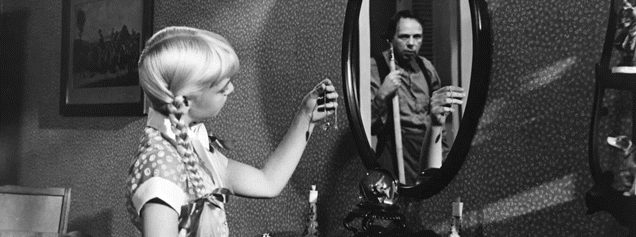
named Rhoda. Rhoda looks sweet and girlish in her pigtails, but beneath her
sweet demeanor, she’s a cunning schemer who doesn't hesitate to resort to
violence to get her way.
Christine’s husband, the Air Force Colonel (William Hopper), and Christine
constantly spoil their unhinged daughter. But the very selfish daughter has a
mania for acquiring gifts and prizes, and she will do anything to get them.
Christine often suspects her daughter’s dark nature, but she won’t fully believe
it. But then when the girl’s schoolmate disappears, she sees concrete evidence
of her daughter’s crime, and she must decide what to do.
The lead, Patty McCormack, was nominated for an Oscar for best supporting
actress, even though she arguably has the most screen time and dominates every
scene she’s in. Like Anthony Perkins, who played Norman Bates in Hitchcock's
Psycho, she never fully
escaped the specter of her unforgettable role, and she often got typecast. She
also appeared in the TV version of The Bad Seed (2018) and its sequel, uncreatively titled The Bad Seed Returns (2022). She also appeared in the more
critically acclaimed Mommy (1995) and its sequel, Mommy 2: Mommy’s Day (1997),
in which she plays a parent with a killer girl, and both can be seen as a sort
of re-imagining or remake of The Bad Seed. Most of Patty’s other work was in TV
shows like The Sopranos and the short-lived The Ropers, where she played the
Ropers' beautiful, wealthy neighbor opposite Jeffery Tambor, who played her
husband. It was a really memorable role in a forgettable show.
The ten-year-old McCormack is perfect as the extremely emotionally unstable
eight-year-old Rhoda Penmark, who can swing wildly. At times she clings to her
mom in a completely dependent and passive manner, and a few minutes later she
will flip into a crazy tantrum, and then after she kills, she lights up like a
bulb with malignant glee. Rhoda Penmark is one of the all-time great, evil cinematic children. She ranks
alongside Damian from The Omen, Claudia from Interview with the Vampire, and
Regan from The Exorcist.
Nancy Kelly reprises a role she won a Tony for on stage in one of her last film
roles (she later did an Alfred Hitchcock Presents episode) as Rhonda’s
conflicted, long-suffering mother, Christine. As the film progresses, she begins
to suspect her daughter’s evil nature, but the disconnect between Rhoda’s
everyday sweetness and her violent potential makes it hard for her to accept
that Rhoda could be capable of such violence.
Eileen Heckart, in the film's third impressive performance, plays a drunk,
grieving mom. Her son was murdered for winning a penmanship award, and she
suspects Rhoda has something to do with his disappearance. But Rhoda’s mom tries
to deny her daughter’s actions until she can't.
Although there is little explicit gore and no on-screen murders in the film, the
movie is very violent for its time, and it is not for the faint of heart. We see
the girl set fire to a home keeper, but the reason it's all so disturbing is
that it’s all done by a normally angelic-looking young girl who is a walking,
talking contradiction.
The film does a good job of thematically exploring the old nature vs. nurture
arguments. It turns out that the girl’s maternal grandmother was a famous
schizophrenic serial killer, but the mom who wants to always please and spoil
the daughter and supports her no matter what part of the problem is also. So,
the film makes us consider whether evil comes from environment and
socialization, or whether people start out as bad seeds and evil can be
inherited. The same theme is explored, but not nearly as well, in the Hammer
film Hands of the Ripper (1972), in which Jack the Ripper's daughter, who has
memory blackouts, suspects she is a murderer.
Like Psycho and Peeping Tom, The Bad Seed helped bring psychoanalytic theory to
center stage in the horror genre. Christine’s father and his friend Monica
(Evelyn Vardon) are deeply knowledgeable about psychoanalysis, and in some
scenes, they use their theories to try to understand Rhoda. I will not reveal it here, but the ending had to be altered in
both the novel and the play. This is because the Hays Motion Picture Production
Code determined that all wrongdoers must be ultimately severely punished. But I
prefer the novel's ending.
The film is an essential classic melodrama that helped shape horror films and
create the "creepy little kid" trope in films and TV.
|