|
 (020126)
The Mastermind is an unexpectedly riveting film that combines suspense and
absurdism as it effectively deconstructs many of the common tropes of pure heist
films like Topkapi (1964) as well as hybrid films like the heist/horror film
Army of the Dead (2021). The Mastermind follows the plans of one of the world’s
most incompetent robbers, and the mostly dry humor occurs when his grand plan to
steal art from a gallery goes wrong in every imaginable, ridiculous way.
The film was one of the best-reviewed American films of 2025, though it did not
receive nominations at most major award shows. It was the second-best film of
the year according to Film Comment and third on the prestigious Sight and Sound
critics’ poll. It narrowly lost the top spot in both polls to
One Battle after Another. (020126)
The Mastermind is an unexpectedly riveting film that combines suspense and
absurdism as it effectively deconstructs many of the common tropes of pure heist
films like Topkapi (1964) as well as hybrid films like the heist/horror film
Army of the Dead (2021). The Mastermind follows the plans of one of the world’s
most incompetent robbers, and the mostly dry humor occurs when his grand plan to
steal art from a gallery goes wrong in every imaginable, ridiculous way.
The film was one of the best-reviewed American films of 2025, though it did not
receive nominations at most major award shows. It was the second-best film of
the year according to Film Comment and third on the prestigious Sight and Sound
critics’ poll. It narrowly lost the top spot in both polls to
One Battle after Another.
The film was directed by Kelly Reichardt, who has been associated with the slow
cinema movement, in which every small event we see in a film is important
because hardly anything else happens. Slow cinema also focuses on complex
personal psychology rather than plot.
Like Certain Women (2016), this film is a little busier, a little faster-moving, and
much
closer to mainstream cinema than Reichardt’s other films. It has more events,
and more is going on than her previous films: Old Joy (2006),
First Cow (2019), and
Showing Up
(2022). Like the films of her mentor Jean Pierre Melville, it balances plot and
psychology more than a typical crime film. This is her best film since the
minimalist masterpiece,
First Cow
which was my #3 pick on my
Best Films of 2020 list.
Like
First Cow,
this film is centered on theft, but both films share other
similarities as well. In the anti-western
First Cow a pair of down on their luck
cowboys steal the milk from their farmer neighbor each night to make bakery
goods to sell (it’s the only cow in the area) while in The Mastermind, a bunch
of losers with few prospects join together to steal some paintings they intend
to fence though the gang's leader-a former art teacher. Like many of Reichardt’s
films, this one focuses on desperate working-class characters with low ambitions
who are living in the margins. There are no big stars in most of her films
except for the ones made with her frequent collaborator, Michelle Williams, who
is absent here. Like the great Neorealist filmmakers, she often gets wonderful
naturalistic performances out of non-actors and unknowns. This usually means that her films earn rapturous reviews, but few people
outside a loyal cult actually come out to see them or even know they exist.
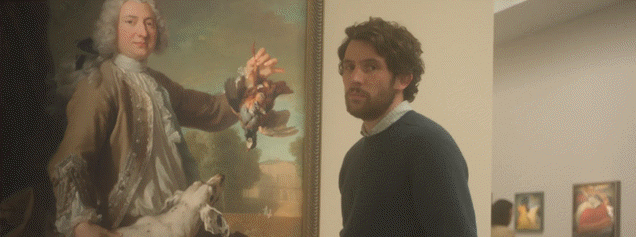
The film is set in a dead-end town in Massachusetts, where everyone has low
ambitions and nothing much happens. The Mastermind focuses on the permanently
bored JB Mooney (Josh O'Connor, marvelous), who is loosely based on a real-life
art thief. Mooney is an underachieving, unemployed cabinetmaker with an arrogant
judge for a dad who constantly berates him for not getting ahead. Mooney is
angry at the world for not giving him what he deserves, and he longs to strike
back at the system that screwed him over. He enlists some low-intelligence
minions to help him steal a bunch of paintings by an abstract painter named
Arthur Dave. But the group is almost as incompetent as the low-life characters
on the Trailer Park Boys. His big plan, which is doomed to fail, is for his two
friends to put pantyhose on their heads to conceal their identities, and, in
broad daylight, to inconspicuously rob the museum while it is still open.
Despite some snafus (one of the thieves has to tussle with an elderly guard),
the thieves manage to escape. But after one of his low-intelligence friends
squeals, the police begin to suspect Mooney.
As the police get closer to catching them, Mooney runs off and abandons his
family without a word and keeps moving around to avoid imprisonment. His friend
suggests that he hide with some mutual friends, and in his endorsement, he says,
“They’re drug addicts and draft dodgers, good people.” He joins the friends at a
commune run by a laid-back hippy couple, and the sequence offers a wonderfully
goofy snapshot of the 60s counterculture. We suspect Mooney will eventually mess
up and get caught, and the suspense generated waiting for this to happen is
enormous.
Josh
O'Connor plays Mooney in a wonderfully restrained performance. He under acts almost as well as the actors in the films of Robert Bresson and
Yasujiro Ozu, both of whom were huge influences on Kelly Reichardt’s career.
O’Connor has been mostly a TV actor, starring in The Durrells and God’s Own
Country, for which he won a BIFA award for Best Actor. He won that award for his
completely convincing performance as a closeted sheep farmer. His most
significant work includes his stint as a very unlikable Prince Charles on The
Crown (2019-2020), as well as a nice, restrained performance in
Challengers
(2024).
The film also stars Alana Haim, one of the better pop singer-actors around. Besides
fronting the Indy band Haim, for which she received five Grammy's. She also acted
in
One Battle after Another (2025) and the upcoming The Drama, in which she will
act alongside Zendaya.
The terrific stop-start score by Rob Mazurek goes very well with the ebbing and
flowing of the film’s action, which starts and stops like a John Cassavetes
film. It is one of the best jazz soundtracks I’ve heard in years (although not
as good as the Miles Davis score for Frantic), and it is a key reason for the
film’s success.
Some may find the film depressing, and it received a really
negative response from mainstream viewers on Rotten Tomatoes, but it might also
make some viewers feel good because, no matter how bad their lives are, they are
probably better than the lead character's. The film also works as a powerful
shout-out to the real-life losers to get their lives straightened out before it
is too late.
|