|
 (101426)
You could make a convincing argument that the 1930s were the best decade of
cinematic horror. Horror became solidified as an independent genre after many
elements were first introduced in 1920’s films like The Golem (1920), Cabinet of Dr.Caligari (1920), Nosferatu (1922), Phantom of the Opera (1925), and the
long-lost London after Midnight (1927). This was the period in which all the
genre elements, Hollywood's production capabilities and the depressions social
unease came together. The 1930s also saw the release of most of the greatest
Universal monster films, establishing many horror franchises, while other
studios released outstanding competing fright films. Some of the era's most
influential masterpieces include Frankenstein (1931), Dracula (1931), Invisible
Man (1932), The Mummy (1933), Island of Lost Souls (1932),
Freaks (1933),
and the crowning jewel, and perhaps the best in the Universal monster series:
The Bride of Frankenstein (1935). It's influence comes down to us today with it
inspiring the recent brilliant
Poor Things
(2023), the disappointing The Bride
(2026), as well as her role in James Gunn's animated
Creature Commandos
(2025).
Almost as good as all these was the most honored 1930s horror film, the 1931
version of Dr. Jekyll and Mr. Hyde (1932) which won a Best Actor Oscar for
Frederic March, an achievement which was almost an unthinkable and unprecedented
honor for a horror film at the time. Although the film is technically not a
werewolf film, its theme of a man whose bestial side escapes went on to
influence The Werewolf of London (1935), The Wolfman (1941), Cat People (1942),
and later the Incredible Hulk character and its comic and film depictions.
This 1932 version is packed with talent. It was directed by the fine Armenian
filmmaker, Robert Mamoulian, who also made the fine Greta Garbo vehicle, Queen
Christina (1933), as well as Becky Sharpe (1935), which also featured Miriam
Hopkins, the female lead of Dr. Jekyll and Mr. Hyde. Hopkins also appeared in
the classic Ernst Lubitsch film Trouble in Paradise (1932). The male lead,
Fredric March, also appeared in The Best Years of Our Lives (1946) and in many
fine film versions of well-known literary classics, such as Anna Karenina (1934)
and The Iceman Cometh (1973). Together they give two of the best performances in
any early horror films.
At the start, Jekyll gives a controversial lecture reminiscent of Frankenstein,
which shocks conventional scientists. Jekyll speaks of the dualism of humankind.
He proposes that humans have good and evil sides at war, and he hypothesizes
that we can accomplish more and/or liberate ourselves if we can separate them.
While he lectures, the setting matches the lecture's themes, with the background
split into light and dark, like the parts of his consciousness. Of course, like
many mad scientists, he tests the chemical on himself, with disastrous results.
In many ways the film also resembles Frankenstein (1931) because both feature
doctors with "out of the box" scientific ideas who are about to marry faithful,
traditional women. Both eventually go on to destroy their lives by delving into
the unknown and trying to play God.
In the case of Dr. Jekyll, since the bride’s dad makes them put off the wedding,
Jekyll feels he cannot sleep with her and consummate the union until the Honeymoon. His sexual tension
builds as the doctor waits for the wedding, all of which eventually feeds into
Hyde. The repression makes it that much worse when Jekyll’s id, Hyde, is finally
unleashed on the world. At one point, Hyde even says, “Do you know what would
happen to a man who is dying of thirst is denied water?”
Dr. Jekyll is a noble character and seems somewhat saintly when the chemical
doesn't initially affect him. When he helps a disabled girl to walk, he seems an
almost Christ-like figure. What makes him even more tragic is the good Jekyll is
still trapped inside when Hyde brutalizes people, and at one point Hyde even
says, “beneath this rough exterior you’ll find the very flower of a man.” When
Hyde reverts to Jekyll, he tries to make up for the damage he caused and help
the people he hurt while his other persona was in control.
There is a struggle inside the good doctor’s consciousness between not just good
and evil, but between the spiritual and animal. Two opposite women mirror
Jekyll's two sides and appeal to them. His fiancé, Muriel (Robe Hobart), whom
Jekyll neglects, is “the good girl” while he goes through his private trauma. At
the same time, the prostitute, Ivy Pierson (Miriam Hopkins in the film’s most
devilishly delicious performance), is the street walker/ “bad girl” who, deep
down, at least partially seems to enjoy being abused by Hyde even while a part
of her pines for the conventional kindness of Jekyll.
As the film builds to its powerful, riveting conclusion, Jekyll seems to suspect
his fate and regrets his pride- and vanity-filled transgression. At one point,
Jekyll speaks to God and says: ”I have trespassed in your domain and gone
further than man should go,” which is a fine counter-punctual bookend to Henry Frankenstein's
declaration: "Now I know what it feels like to be god".
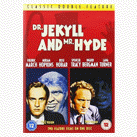
The Warner Classic Double Feature DVD features the reconstructed version which
includes scenes cut from the original 1932 release due to censorship issues. One
scene is of Miriam Hopkins’ sensual striptease, which ran into censorship problems
and was cut from some prints of the film. Censors also thought Hyde’s
performance was too brutal and sensual, and they toned it down in several ways
both in preproduction and after it was finished. Some, but not all, of it was
restored, while some parts were discarded. For instance, we never get to see a
legendary scene that may never have been shot: Hyde throwing a cat into a river.
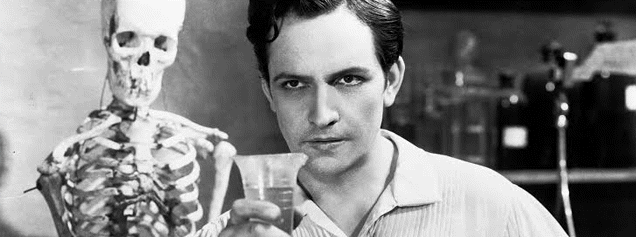
This is still the best and definitive film version of the story, and March’s
Hyde remains the most shocking and animalistic. March’s Hyde, which required
several hours of makeup, has oversized, grotesque teeth, huge hands, and a
simian-like posture, and his character loved torture for its own sake. This
depiction would have been unthinkable just a few years later, after the
Production Code took effect, which explains why the later Spencer Tracy version,
still quite good, seems so sanitized, toothless, and restrained in comparison.
Speaking of which, the other film in the Warner Classic Double Feature DVD set includes
the 1941 version with Spencer Tracy. The March version relies more on makeup,
but almost ten years later the Tracy version conveys Hyde through acting rather than
makeup or special effects. Tracy’s version also reverses typecasting by making
the usually saintly Ingrid Bergman the prostitute and Lana Turner, often cast as
the femme fatale, the fiancé. The role switching works only partially: Bergman,
one of my favorite actresses, is unforgettable as the streetwalker, but Turner,
who was great in The Postman Always Rings Twice (1946) and The Bad and the
Beautiful (1952), is as dull as dishwater.
The DVD set also includes an interesting Bugs Bunny short, Hyde and Hare, a
trailer for the 1941 film, and fascinating commentary by Greg Mank. The whole
DVD package is highly recommended, and it is especially essential viewing for
classic horror fans. The films take you back to a time when most horror
protagonists were deeply sympathetic, and it took much less to scare people. The
two Hyde films may be less scary than they were at release, but their marvelous
performances and superior dramatic peaks still make them worth seeing. And the
extras are like sugar on top.
|