|
 (100726)
When Let’s Scare Jessica to Death was originally released, it was highly
polarizing for audiences. Most critics found it disjointed, with a vague story
and a hard-to-pin-down plot. But others appreciated its dream logic narrative
and saw the film as an underappreciated cult classic. Stephen King called it
“quite simply one of the best ghost stories ever filmed. Also, the Chicago Film
Critics Association deemed it one of the scariest films ever in their 2012 poll,
and it made the Sight and Sound poll as one of the 1000 greatest films ever
made. Although the film has its flaws, I see many strengths, and it succeeds in
de-centering the audience and blurring the line between fantasy and reality.
Let’s Scare Jessica to Death is a fine and underrated psychological horror film
full of surreal images that could only have been made in the 70s. Like
Messiah
of Evil (1973), the film has been interpreted as a commentary on the end of the
swinging sixties counterculture, a critique of progressive sexual
permissiveness, and society's generational split. It could be read as a
cautionary tale on the dangers of getting too involved with bohemian types you
don’t know too well. The film’s main heroes retire to start a simpler life and
build a utopia in the woods to escape society's mundane rules. But it all goes
terribly wrong.
Also, like the similar film
Messiah of Evil, the film is told from the
first-person point of view of a woman who witnesses supernatural phenomena and
may or may not be clinically sane. Both films also feature zombie/vampire hybrid
creatures with characteristics of both species. Although they feed on blood and
bite people in the neck, they also shamble mindlessly like a herd of zombies in
George Romero's
Night of the Living Dead (1968). It seems like it took a while for the zombie
idea from Night of the Living Dead to solidify. Most of the zombies seem to be
middle-aged men who always follow their leaders like herd members and look
disapprovingly at the young protagonists. That might be the way hippies and
countercultural types saw older members of “square” society.
The film was skillfully made by John Hancock, who directed
many theatrical plays including some Shakespeare dramas. But he is best known
for the terrific baseball film, Bang the Drum Slowly (1973), which features a
classic performance by Michael Moriarty as well as an important, early breakout
performance by a young Robert De Niro. But Hancock never did anything as
significant as either of these two films again.
Three main performances by well-cast actors anchor the film. Zohra Lampert, who
was in Exorcist III, delivers a totally unforgettable lead performance, and it’s
right up there with Indi Navarrete’s performance in this year's
Obsession
(she’s slated to play Rogue in an upcoming Marvel film). Barton Heyman from The Exorcist (1973),
who plays her husband, and Kevin O Connor, his hippie friend, are also adequate.
Like Henry James's classic novel The Turn of the Screw, and its best film
version, The Innocents (1961), which I may review here soon, the main character
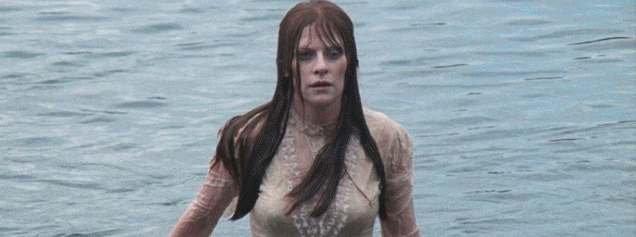
is a very unreliable narrator. She continually sees bizarre stuff that no one
else seems to see, like floating bodies and a drowned girl, and she always hears
voices whispering, which seem to be talking directly to her, as well as loud
heartbeat sounds.
The film has been compared with some justification to Sheridan Le Fanu's classic
lesbian vampire novel Carmilla (1872), which was also adapted into Vampyre
(1932), Blood and Roses (1960), Crypt of the Vampire (1963), The Vampire Lovers
(1970), The Blood Splattered Bride (1972), Carmilla (2017) and Carmilla (2019).
But Let's Scare Jessica to Death (1971) is not strictly speaking an adaptation
of the novel, but like Dracula's Daughter (1936), it seems at least partially
inspired by it. In both Carmilla and this film, a mysterious woman with nowhere
to stay who looks identical to a long-dead woman in a painting. And
blood-drained bodies begin to pile up as she seduces everyone around her. But
this film lacks the lesbian themes and implications of the other films.
The basic setup is similar to the classic Ingrid Bergman film, Gaslight (1944).
Both films feature women just out of an asylum who see strange things that cause
other people to start to question their sanity. In this case, the title
character, Jessica (played very convincingly by Zohra Lampert of The Exorcist
III), was just released from a sanitarium. Jessica retires to recover and leads
a quiet life on an isolated farm. She is accompanied by her not-overly-bright
husband, Duncan (Barton Hayman also from Exorcist III), who seems not to
understand what’s going on around him and fails to see that he's being
manipulated and controlled. He reminded me a bit of the thick husband seduced by
the female werewolf in The Howling (1981). Also on hand is Kevin O Connor of The
Brink's Job (1978) as their free-spirited hippie friend Woody. His hedonism and
spontaneous lifestyle are his tragic flaws, which lead to his downfall. Marciare
Catherine Costello from The Waltons (1972-77) is enigmatic and sinister, playing
Emily in the dual roles of the ghost of a drowned girl and a vampire who are
probably the same person.
Jessica, Duncan, and Woody soon meet a homeless hippie chick, Emily (Mariclare
Costello), who is like a monstrous, vagabond version of Joni Mitchell, with an
enigmatic, radiant smile and a guitar always in hand. She is a mysterious
homeless girl who has been squatting in their house. Jessica likes her and feels
sorry for her, so she allows her to keep staying at the house. When Emily, with
her long red hair, strummed her guitar and did a musical duet with Jessica, they
reminded me of a very sinister version of Dave Crosby and Joni Mitchell. If this
were another kind of film, it could have been a setup for a romantic threesome
or even a foursome, but the film goes in another direction.
Emily's first shot is especially significant and striking. We see a young woman
with long red hair in a rocking chair, but her face is covered up because a pole
is in the way. Then, when the camera goes back to the scene a second later, she
disappears as if she was never there. This adds to the feeling that she is
ghostly, insubstantial, or not quite real.
Almost immediately, Jessica suspects she made a big mistake. Emily is shrouded
in mystery and seems connected to disturbing local legends. Also, Emily flirts
with every guy and acts seductive around Jessica’s husband. She is a spitting
image of Abigail, a lovely girl in a painting who drowned in a pool behind the
couple’s house before she was supposed to marry. If this is not bad enough,
Abigail/Emily has a hypnotic effect on all the men in the town. Also, all the
men have weird wounds on their necks, and local legends say that if a person
commits suicide, they may be damned to rise as a vampire and live in eternal
torment.
Strange things happen, and the bodies begin to multiply. A local antique guy is
killed fishing, and like many local villagers in these films, he is obvious
cannon fodder. Also, a mute girl leads Jessica to another body. The mute girl is
obviously terrified of Emily, perhaps because she knows his full nature. Like
the oracle in The Odyssey, the mute girl has compensating powers to make up for
her infirmity, and she seems to know more than anyone else about certain things;
she also has psychic powers.
The film has very little gore, but it is still very disturbing for a PG horror
film. In one scene, we see a man on a lawn mower, and a bit later we see the
same man on the lawn mower in the same position with the top part of his body
ripped off.
The film is also one of the first films to make extensive use of electronic
music on its soundtrack. The minimalist electronic score creates an atmosphere
of dread, which perfectly accompanies some of the most disturbing dream images
since A Carnival of Souls.
Not all the images gel together, and the film works best as random images and
dreams in the mind of a woman whose mind is teetering toward insanity. And the
images she sees could be Jessica’s mind pushing her towards suicide to emulate
the dead girl in the legends.
Let’s Scare Jessica to Death is a chilling, emotionally resonant thriller that
was initially ignored but gained a cult following. The film is nuanced and
detailed, rewarding viewers who revisit it multiple times. Because the film
begins as it ends, viewers can watch it as an endless, repeatable loop.
|